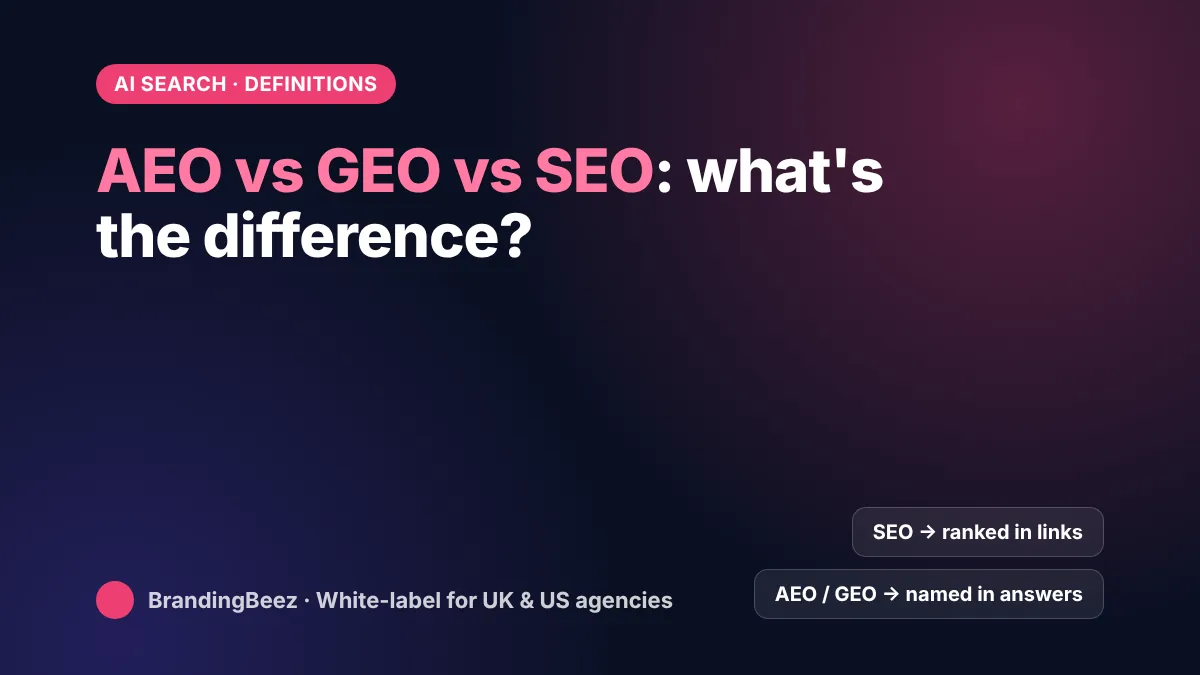
SEO gets a business ranked in search results. AEO and GEO get it named in AI answers. Here's what each term means, how they overlap, and which one to sell.
SEO (search engine optimisation) is the work of getting a website ranked in search results, such as Google's list of links.
AEO (answer engine optimisation) is the work of getting a business named and quoted in answers from AI assistants and answer boxes, such as ChatGPT, Claude, Perplexity and Google's AI Overviews.
GEO (generative engine optimisation) means almost the same as AEO. The term comes from research on how to make content more likely to be cited by generative AI. In practice, agencies use AEO and GEO interchangeably. Some also say AIO (AI optimisation).
How they differ
| SEO | AEO / GEO | |
|---|---|---|
| The goal | Rank in a list of links | Be named or quoted in the answer |
| What the user sees | Ten blue links, ads, a map | One answer, often naming two to five businesses |
| What it relies on most | Relevance, links, technical health | Clear identity, third-party mentions, quotable facts |
| How you measure it | Rankings, clicks, traffic | Mention rate across a set of buyer questions |
How they overlap
A lot. A fast, crawlable site with clear content and good schema helps both. The difference is emphasis: AEO puts more weight on what other sites say about the business, consistent details across listings, and specific facts AI can quote.
Which should an agency sell?
Both, together. Clients still get most of their traffic from search, and AI answers increasingly decide who gets shortlisted. Adding AEO to an existing SEO retainer is the simplest way to start. Our guide to packaging AI visibility shows how.
See where any website stands: our free AEO checker runs the six checks from our AI visibility audit in about a minute.
Run a free AEO checkReady to Get Started?
Contact our expert team to discuss how we can help grow your business with proven digital marketing strategies.