



Quick Summary
A high-converting website is not about looks alone. This guide explains how agencies can design conversion-focused website architecture that guides users, reduces friction, and increases leads.
Table of Contents
Introduction: Why Website Architecture Matters for Conversions
Most websites fail not because they look bad, but because they are confusing. Visitors land on the site, struggle to find what they need, and leave without taking action.
For agencies, real success means building websites that guide users clearly from entry to conversion. This is where conversion-focused website architecture plays a critical role. It defines how pages are structured, how users move through the site, and how calls-to-action are placed.
This guide breaks down a simple, proven website architecture framework agencies can use to design sites that convert consistently. This conversion-first methodology is how leading digital agencies differentiate themselves by delivering websites that generate measurable business results, not just aesthetic appeal.
For agencies, real success means building websites that guide users clearly from entry to conversion. This is where conversion-focused website architecture plays a critical role. It defines how pages are structured, how users move through the site, and how calls-to-action are placed.
This guide breaks down a simple, proven website architecture framework agencies can use to design sites that convert consistently. This conversion-first methodology is how leading digital agencies differentiate themselves by delivering websites that generate measurable business results, not just aesthetic appeal.

Website Architecture Is a Guided User Journey
Think of website architecture as planning a journey. Each page should move the user one step closer to a goal booking a call, submitting a form, or making a purchase.
A strong conversion architecture:
- Reduces confusion
- Shows users where to go next
- Makes actions obvious and easy
Without this structure, even great design and copy will underperform.
A strong conversion architecture:
- Reduces confusion
- Shows users where to go next
- Makes actions obvious and easy
Without this structure, even great design and copy will underperform.
1. Information Hierarchy That Matches User Intent
Users visit websites with different intentions. Your architecture must reflect this.
Align Pages With the Buyer Journey
Organise pages around intent:
- Awareness: Blog posts, guides, overview pages
- Consideration: Service pages, feature explanations, case studies
- Decision: Contact pages, pricing, booking forms
Navigation and internal links should move users naturally between these stages.
- Awareness: Blog posts, guides, overview pages
- Consideration: Service pages, feature explanations, case studies
- Decision: Contact pages, pricing, booking forms
Navigation and internal links should move users naturally between these stages.
Keep Important Pages Easy to Reach
Key actions should never be buried.
- Important pages should be reachable within a few clicks
- Avoid deep menus and complex navigation structures
Agencies specializing in conversion-focused web development structure information architecture during the wireframe phase, ensuring critical conversion paths are optimized before any visual design begins.
- Important pages should be reachable within a few clicks
- Avoid deep menus and complex navigation structures
Agencies specializing in conversion-focused web development structure information architecture during the wireframe phase, ensuring critical conversion paths are optimized before any visual design begins.
2. Page Templates Built for Conversion
Not all pages serve the same purpose. Each type needs a clear structure.
Service Pages (High-Conversion Pages)
These pages should include:
- Clear value proposition at the top
- Benefits explained in simple language
- Proof such as testimonials or logos
- A strong, visible call-to-action
Professional website design and development teams create standardized high-conversion templates for service pages, ensuring consistent performance across all client offerings while maintaining brand uniqueness.
- Clear value proposition at the top
- Benefits explained in simple language
- Proof such as testimonials or logos
- A strong, visible call-to-action
Professional website design and development teams create standardized high-conversion templates for service pages, ensuring consistent performance across all client offerings while maintaining brand uniqueness.
Content Pages (Traffic Builders)
Blogs and guides should:
- Educate first
- Internally link to relevant services
- Include a soft CTA like “Book a consultation” or “Learn more”
- Educate first
- Internally link to relevant services
- Include a soft CTA like “Book a consultation” or “Learn more”
Contact and Pricing Pages
These pages should remove doubt:
- Simple forms
- Clear next steps
- Reassurance about response time and process
- Simple forms
- Clear next steps
- Reassurance about response time and process

3. Simple Navigation and Clear Direction
If users feel lost, they leave.
Use Clear Navigation Labels
Avoid creative but unclear menu names. Use:
- Services
- Work
- About
- Contact
Clarity always beats creativity for conversions.
- Services
- Work
- About
- Contact
Clarity always beats creativity for conversions.
Always Show the Next Action
Include a visible CTA button such as:
- Get a Quote
- Book a Call
- Start a Project
This should be accessible from every page.
- Get a Quote
- Book a Call
- Start a Project
This should be accessible from every page.
Use Smart Internal Linking
Internal links help users and search engines.
- Link blogs to service pages
- Link service pages to case studies
- Guide users deeper into the funnel naturally
- Link blogs to service pages
- Link service pages to case studies
- Guide users deeper into the funnel naturally
4. Performance and Trust Built Into the Structure
Speed and trust are not optional.
Website Speed Impacts Conversions
A slow website increases bounce rates. Conversion-focused architecture includes:
- Optimised images
- Clean code
- Reliable hosting
Agencies offering comprehensive web development services prioritize Core Web Vitals and performance optimization as non-negotiable elements of conversion architecture, not optional enhancements.
- Optimised images
- Clean code
- Reliable hosting
Agencies offering comprehensive web development services prioritize Core Web Vitals and performance optimization as non-negotiable elements of conversion architecture, not optional enhancements.
Place Trust Signals Where Decisions Happen
Trust elements should appear near CTAs:
- Client logos
- Testimonials
- Guarantees
- Security badges
This reduces hesitation at the moment of action.
- Client logos
- Testimonials
- Guarantees
- Security badges
This reduces hesitation at the moment of action.
How Agencies Can Implement This Architecture
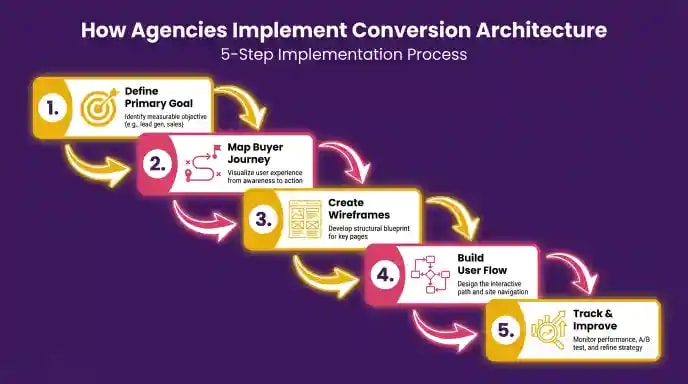
A simple process agencies can follow:
- Define one primary conversion goal
- Map pages to the buyer journey
- Create wireframes focused on flow, not design
- Build pages that guide users step-by-step
- Track behaviour and improve over time
Agencies seeking to implement conversion-focused architecture systematically partner with experienced development teams like BrandingBeez to ensure technical performance, user flow optimization, and conversion tracking are integrated from the foundation. Agencies implementing structured conversion architecture consistently achieve higher client satisfaction and project success rates documented case studies demonstrate how systematic user flow optimization directly impacts lead generation and sales outcomes.
can implement conversion-focused architecture faster while maintaining technical performance and scalability.
- Define one primary conversion goal
- Map pages to the buyer journey
- Create wireframes focused on flow, not design
- Build pages that guide users step-by-step
- Track behaviour and improve over time
Agencies seeking to implement conversion-focused architecture systematically partner with experienced development teams like BrandingBeez to ensure technical performance, user flow optimization, and conversion tracking are integrated from the foundation. Agencies implementing structured conversion architecture consistently achieve higher client satisfaction and project success rates documented case studies demonstrate how systematic user flow optimization directly impacts lead generation and sales outcomes.
can implement conversion-focused architecture faster while maintaining technical performance and scalability.
Conclusion
A conversion-focused website is not just a digital brochure. It is a structured system designed to guide users, build trust, and generate business results.
When agencies focus on website architecture not just design they deliver measurable ROI and build websites that truly perform. This ROI-focused approach to web projects is the foundation of how performance-driven agencies retain clients long-term by consistently demonstrating business impact through conversion data rather than design aesthetics.
When agencies focus on website architecture not just design they deliver measurable ROI and build websites that truly perform. This ROI-focused approach to web projects is the foundation of how performance-driven agencies retain clients long-term by consistently demonstrating business impact through conversion data rather than design aesthetics.
FAQ
What is conversion-focused website architecture?
It is the strategic structure of a website designed to guide users toward a specific action like leads or sales.
Why does website architecture impact conversions?
Poor structure creates confusion, while clear architecture reduces friction and improves decision-making.
How does website architecture help SEO?
Clean structure and internal linking help search engines understand content and rank pages better.
Can conversion architecture be improved on an existing website?
Yes. Through audits, navigation fixes, and improved internal linking.
How many CTAs should a website have?
Each page should have one primary CTA to avoid distracting users.
Ready to Get Started?
Contact our expert team to discuss how we can help grow your business with proven digital marketing strategies.