
Most agencies don't need a full-time hire. They need reliable capacity that matches their workload. Here's how to decide between a part-time and a full-time dedicated specialist.
The agencies we work with rarely start by asking for "a developer". They start with a problem: "We keep turning work down", or "Our designer is booked solid until March", or "We won a big SEO client and can't service it properly". A dedicated resource solves that problem, but only if you choose the right amount of capacity.
What a dedicated resource is (and isn't)
A dedicated resource is a specialist (an SEO executive, WordPress developer, designer, video editor or PPC manager) who works only on your agency's clients, inside your tools and processes. They join your Slack or Teams, take tasks from your project board and follow your standards. Your clients only ever see your agency.
It isn't a freelancer juggling ten other clients, and it isn't a project you hand over and wait for. It's an extension of your team, without recruitment, payroll or HR.
When part-time is the right choice
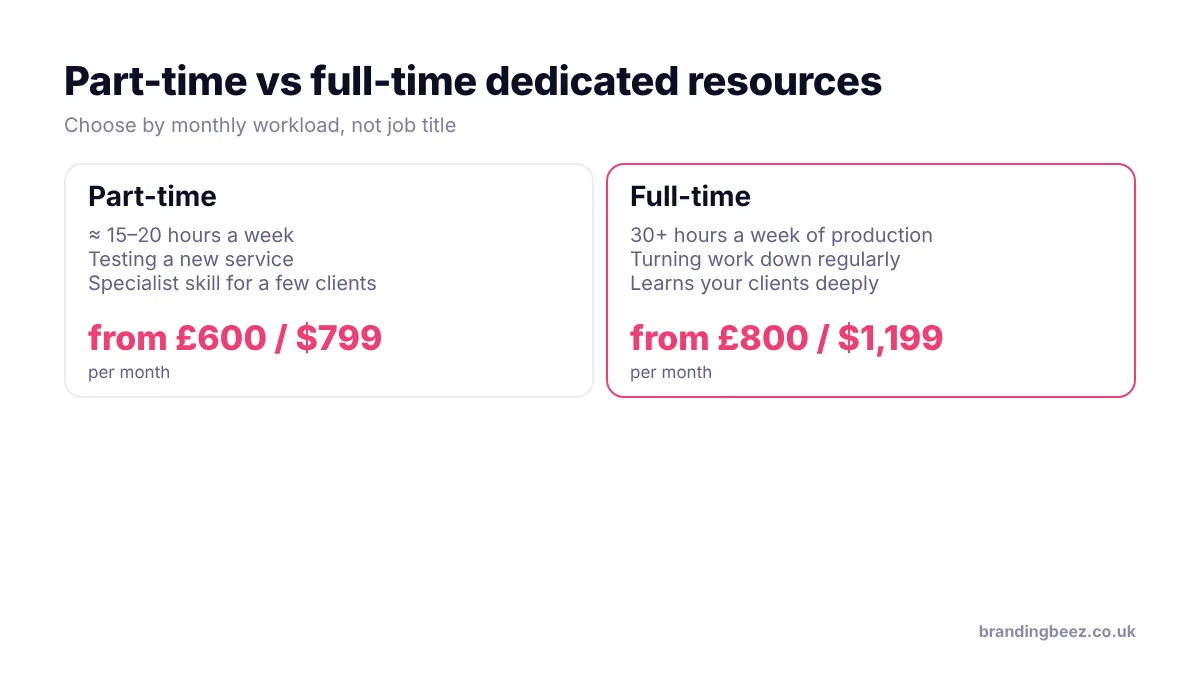
- You have steady but uneven work, roughly 15–20 hours a week.
- You're testing a new service (for example, adding SEO or AI search) before committing.
- You need a specialist skill for a few clients, such as technical SEO or schema, not a generalist.
- Your team is in the UK or US and needs a few hours of overlap, not all-day availability.
Our part-time specialists start from £600 / $799 a month.
When full-time pays for itself
- You're consistently turning work down or pushing deadlines.
- One service line, such as websites or monthly SEO, has more than 30 hours a week of production.
- You want someone who learns your clients deeply and can handle day-to-day changes without a briefing every time.
- You're building a retainer-based service and want predictable capacity behind it.
Full-time specialists start from £800 / $1,199 a month, a fraction of what a local hire costs once you add salary, employer taxes, software and recruitment.
A simple rule of thumb
Add up the hours of production work you turned down, delayed or did yourself late at night last month. Under 80 hours: start part-time. Over 120 hours: go full-time. In between: start part-time and scale up after a month, which you can do without re-hiring.
Make the first month count
- Give them one client or service line to own, not scattered tasks.
- Share your templates, brand guides and checklists on day one.
- Agree on a daily update format and a weekly 15-minute check-in.
- Review after four weeks and decide whether to scale up, scale down or swap skills.
Tell us what you're turning down and we'll suggest the right setup, part-time or full-time.
Explore dedicated resourcesReady to Get Started?
Contact our expert team to discuss how we can help grow your business with proven digital marketing strategies.