We ran live AI visibility audits for UK and US agencies across nine webinar sessions. The same five problems came up again and again, and most take an afternoon to fix.
Since October we've run our AI Visibility Audit webinar nine times for marketing agencies in the UK and the US. In every session we ask the same thing: "What does ChatGPT say about your agency?" Then we audit one or two attendees' websites live, on screen.
The results surprised a lot of people in the room. Some agencies were described accurately. Others found ChatGPT confidently stating the wrong services, the wrong location, or recommending a competitor down the road instead. These were good agencies with decent Google rankings. The issue was how AI tools read and trust their websites, and that works differently from traditional SEO.
Here are the five problems we saw most often, in order of how often they came up.
1. AI tools can't confirm where you are
The most common gap was a missing or partial address. Many agencies work remotely or from home and, understandably, don't want to publish a street address. But AI assistants lean heavily on consistent location signals when they decide who to recommend for "best web design agency in Brighton" or "SEO company near me".
What to do: show a full business address if you have one, and make it identical everywhere: website footer, Google Business Profile, directories and Companies House. If you genuinely can't show an address, be explicit about the areas you serve and list them on a dedicated page. Several attendees asked about virtual offices. They can work, but only if the same address appears consistently across every listing.
2. Key facts are hidden inside JavaScript
Animated counters ("250+ projects delivered", "12 years in business") look great to people. But many AI crawlers read the raw HTML and don't run JavaScript, so a counter that starts at zero and animates upwards is read as… zero. The same goes for reviews loaded by a widget and services shown only inside sliders or tabs.
What to do: make sure your most important facts (services, locations, years in business, results) appear as plain text in the page's HTML. A quick test: view the page source (Ctrl+U) and search for the fact. If it isn't there, an AI crawler probably can't see it either.
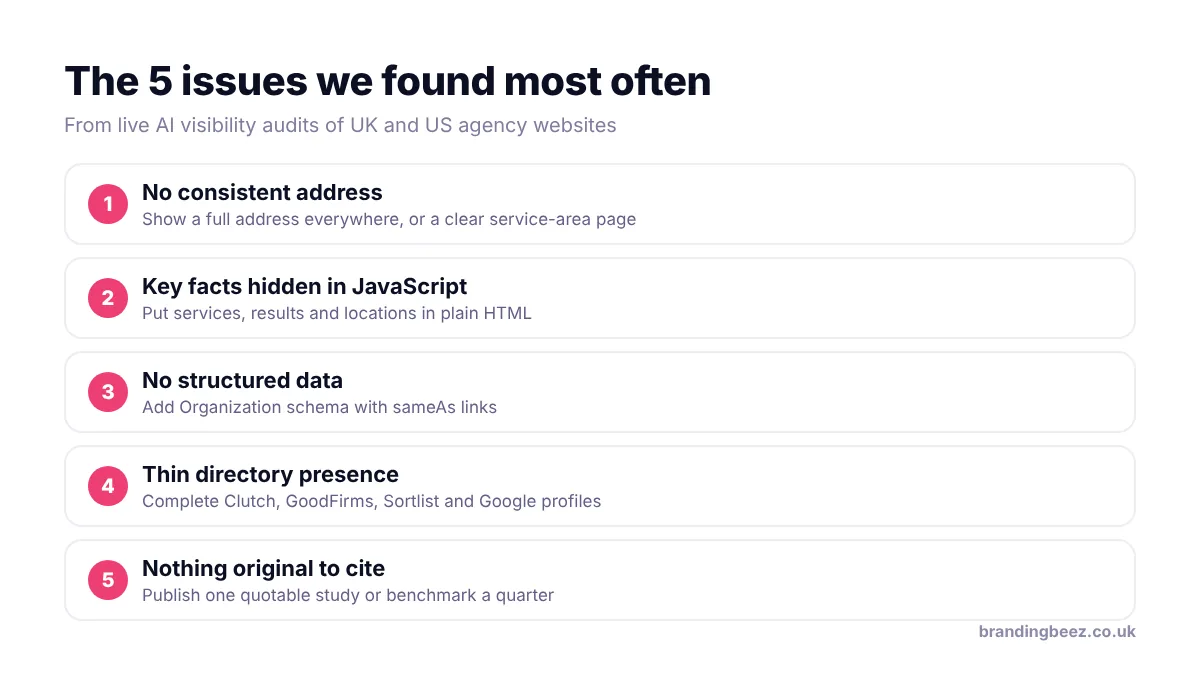
3. No structured data connecting the dots
Most sites we audited had little or no schema.org structured data. This is the code that tells search engines and AI tools, in a format they can read without guessing, who you are, what you do and where you are.
The single most useful property we showed was sameAs. It links your website to your LinkedIn page, Clutch profile, Companies House record and other listings, so an AI tool can be confident they all describe the same business.
What to do: add Organization or ProfessionalService schema to your homepage with your name, URL, logo, phone, address and a sameAs list. Check it with the Schema Markup Validator, the same tool we use live in the webinar.
4. Thin presence on the sites AI tools actually read
When AI assistants answer "who are the best agencies for X", they quote and cite third-party sources: directories, review sites, comparison articles and industry lists. Agencies that only exist on their own website and LinkedIn rarely get named.
What to do: claim and complete your profiles on the directories that matter for agencies, such as Clutch, GoodFirms, DesignRush, Sortlist and your Google Business Profile, and ask a few happy clients for reviews there. Keep the description and services identical across all of them.
5. Nothing original worth citing
AI tools prefer sources that say something specific. "We are a full-service digital agency passionate about results" gives them nothing to quote. A page that says "we audited 40 local trades websites and 31 had no service-area schema" gives them a fact and a reason to cite you.
What to do: publish one piece of original material each quarter, such as a small study, a benchmark from your own client data, or a clear opinion on a question your clients keep asking. This article is our own attempt at exactly that.
Why this matters for agencies specifically
Agency owners in our sessions raised two worries. First, that AI search might take enquiries away from their own agency. Second, that clients will soon ask "why aren't we showing up in ChatGPT?" and expect an answer.
Both are reasonable. But this is also the biggest new service opportunity agencies have had in years. The fixes above are practical, measurable and repeatable across a whole client list. Agencies that learn to check and improve AI visibility now can sell it to every client they already have.
Want to see how one of your clients shows up in ChatGPT, Gemini and Perplexity? We'll run the check for free and send you a white-label report.
Get a free AI visibility checkQuick checklist
- Full, consistent business address (or a clear service-area page)
- Key facts in plain HTML, not only in animations or widgets
- Organization or ProfessionalService schema with
sameAslinks - Complete profiles on the main agency directories, with reviews
- At least one piece of original, quotable content
Ready to Get Started?
Contact our expert team to discuss how we can help grow your business with proven digital marketing strategies.